
Social media got fully reworked in 2025
Most of us use some type of social media everyday. And yet, despite frequent usage, we rarely pay attention to what's happening behind the scenes unless things start to feel... off.
So if 2025 felt weird to you, I'm happy to tell you, there might be a behind-the-scenes reason for that. Quite a few of our favorite social media platforms completely retooled the way they serve content to people over the past year. You may have noticed it as a user... but for businesses, these changes can be make or break.
Let's get into what happened.
Part I: X marks the (wrong) spot
To quote Forbes, Twitter (now X) faced "an exodus of users once Musk purchased and rebranded the platform." While some users returned when Musk handed the reins to new CEO, it faced "another user exodus after Trump won the 2024 election and enlisted Musk, a major trump donor, as an adviser."
X has about 561 million users, a much smaller number than other platforms (Meta has some 4 billion users across its core platforms, including Facebook and Instagram). However, when you look at *active* users, the numbers get even smaller—just under 130 million in late 2025.
Or, to summarize...
About 20 million people stopped using X regularly over the past year.
So... where did they go? The data shows they moved to Threads (owned by Meta)... and to a lesser degree Bluesky and Truth Social, where usage is dominated by political affiliation. For the professionally-focused users who used X for networking... that engagement shifted to LinkedIn.
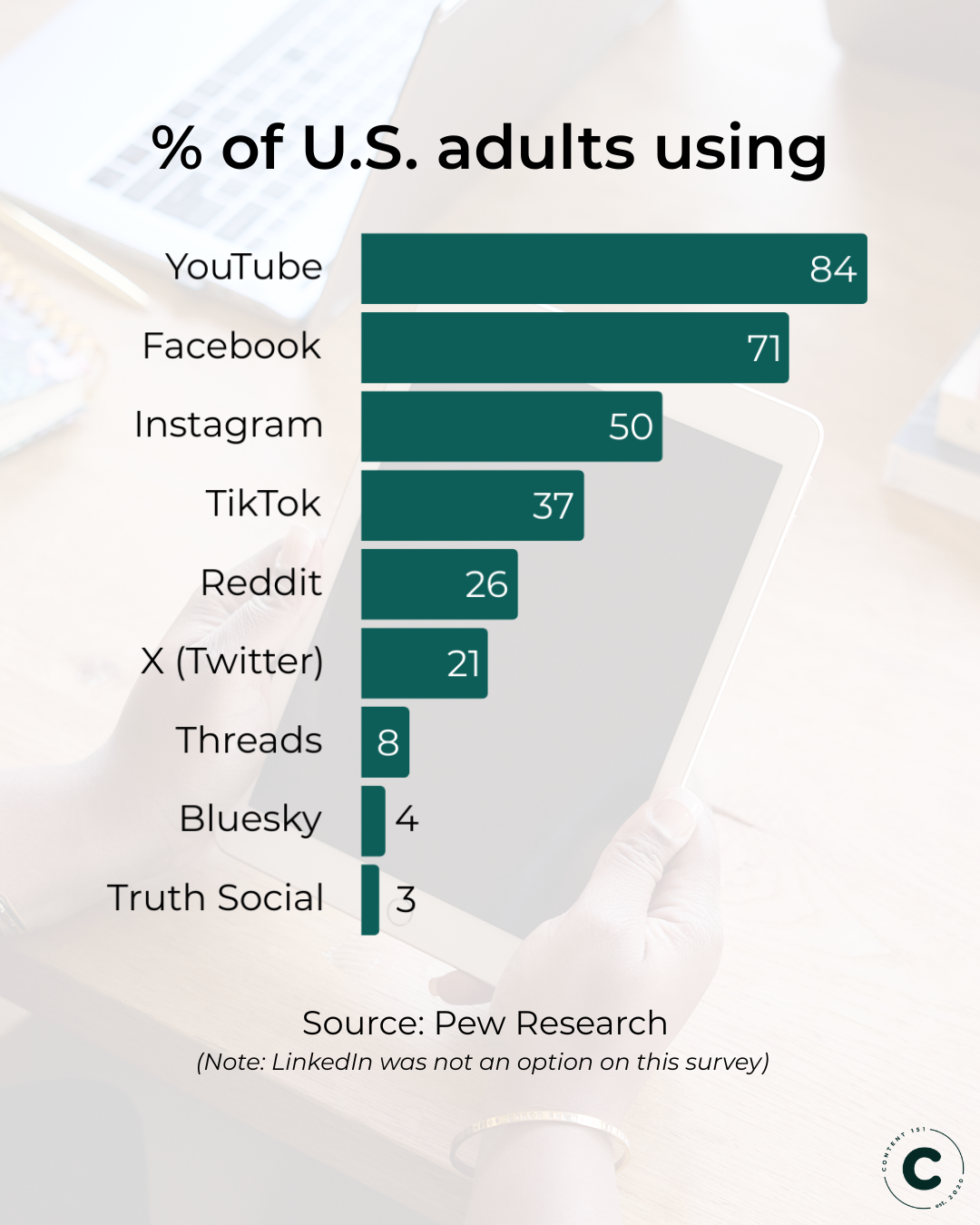
Before we get into that, a reminder that the numbers in this section are global. Here's how adults in the U.S. self-reported their social media in 2025.
Part II: The rise (and retooling) of LinkedIn
In early 2025, LinkedIn surpassed 1.1 billion users. More than 300 million people are using it actively—monthly usage has nearly doubled since 2019. Which is to say—there's reason to believe that the when people left X, they went to Threads/Bluesky/Truth Social for their politics and news, Instagram and Facebook for their truly social content, and LinkedIn for their professional needs.
It's no surprise that the number of people checking LinkedIn increased. But this shift isn't all upside.
More people using LinkedIn means companies and creators took note... and started posting more. (This was accelerated by AI—it's easy to post more when you can ask Chat GPT to write your content.)
The folks at LinkedIn began reworking the platform's algorithms in response to these shifts. To quote one marketing expert:
"It's changed more than I've ever seen before."
Before I explain how, it's worth noting that LinkedIn marches to the beat of its own drum: It calculates metrics differently than other social platforms; the way it syncs with third-party sites can create discrepancies; it treats personal and company profiles differently when it comes to tagging; and so on.
Key changes to LinkedIn
It's prioritizing "real connection." Of course, this authenticity is notoriously hard to measure. LinkedIn decided to judge authenticity based on how people engage with your content. In other words: If someone posts a lengthy comment on your post, it carries significantly more weight than a like.
Timing matters... just not how you think. LinkedIn has never been a time sensitive platform like Twitter once was (you rarely go here for breaking news updates, for example). However, the algorithm used to be setup to prioritize posts that did well in the first hour they were posted. In other words, if a lot of people liked your content right away, the platform thought it had potential to go viral and amplified it. That's no longer the case. Now, the algorithm weighs how much time people spend engaging with your post... versus when you shared it. It's all part of the push toward quality and authenticity.
Relevance has never been more relevant. Pardon the pun, but LinkedIn wanting to serve users quality content is all about relevance. The site will look at the last 5-10 posts you engaged with, figure out what you're interested in, and serve you recommended content based on that. Ever notice that when you comment on an ex colleague's new job, and see what others were saying / engage with their comments... that you start seeing a wave of content from our former colleagues? The same principle applies to how LinkedIn recommends your (and your company's) posts to others.
LinkedIn is penalizing "low quality" content—the type of content designed to solicit likes and follows—clickbait content, if you will. It's no coincidence that this the type of content often generated by AI.
Personal over professional. People tend to engage more with other people than with a brand. This isn't really an algorithm shift, but all of the changes to the algorithm listed above have, by default, tended to elevate personal posts and profiles more than branded accounts.
The above list means many businesses and creators saw their LinkedIn metrics plummet in 2025. I've seen folks share statistics with drop-offs as big as 65% and the general feedback in the marketing community is that fewer people saw posts, leading to lower engagement, and a negative spiral from there.
Of course, that wasn't a universal phenomenon. The new algorithm also generated opportunities. And we'll dive into winning on LinkedIn using the new algorithm in next month's newsletter.
NOTE: I'm focusing on LinkedIn this month and next because it's the platform I get the most questions about from advisors. However, Meta (Facebook and Instagram) and YouTube also unveiled major overhauls to their algorithms in 2025. So did Google, if we want to move past social media. So tell me…
Part III: Not all platforms are universal
Which social platform you pay attention to will depend on who your ideal clients are. For instance, many of the advisors I work with love LinkedIn because it's where they connect with their colleagues... but there may be a better platform to use for connecting with clients and prospects.
If that's the case, nothing I just shared will be particularly relevant to you. The key to a social media strategy isn't posting everywhere, it's understanding the platform that works best for you/your clients... and mastering it.
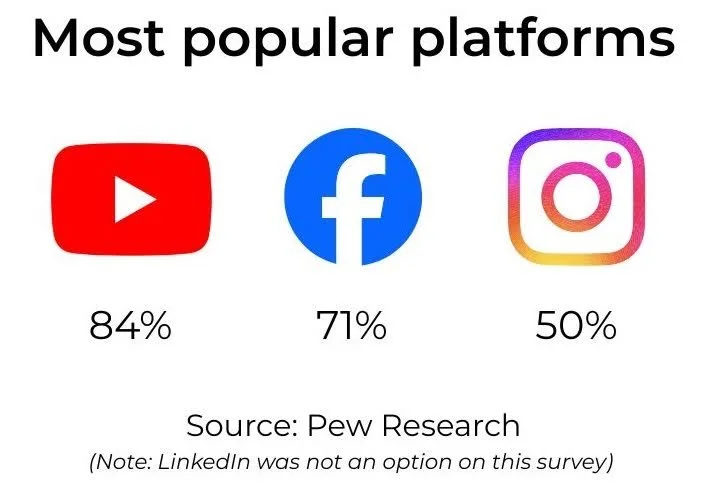
With that in mind, here to the right is how the different demographic groups used social in 2025, based on Pew Research and additional user data.
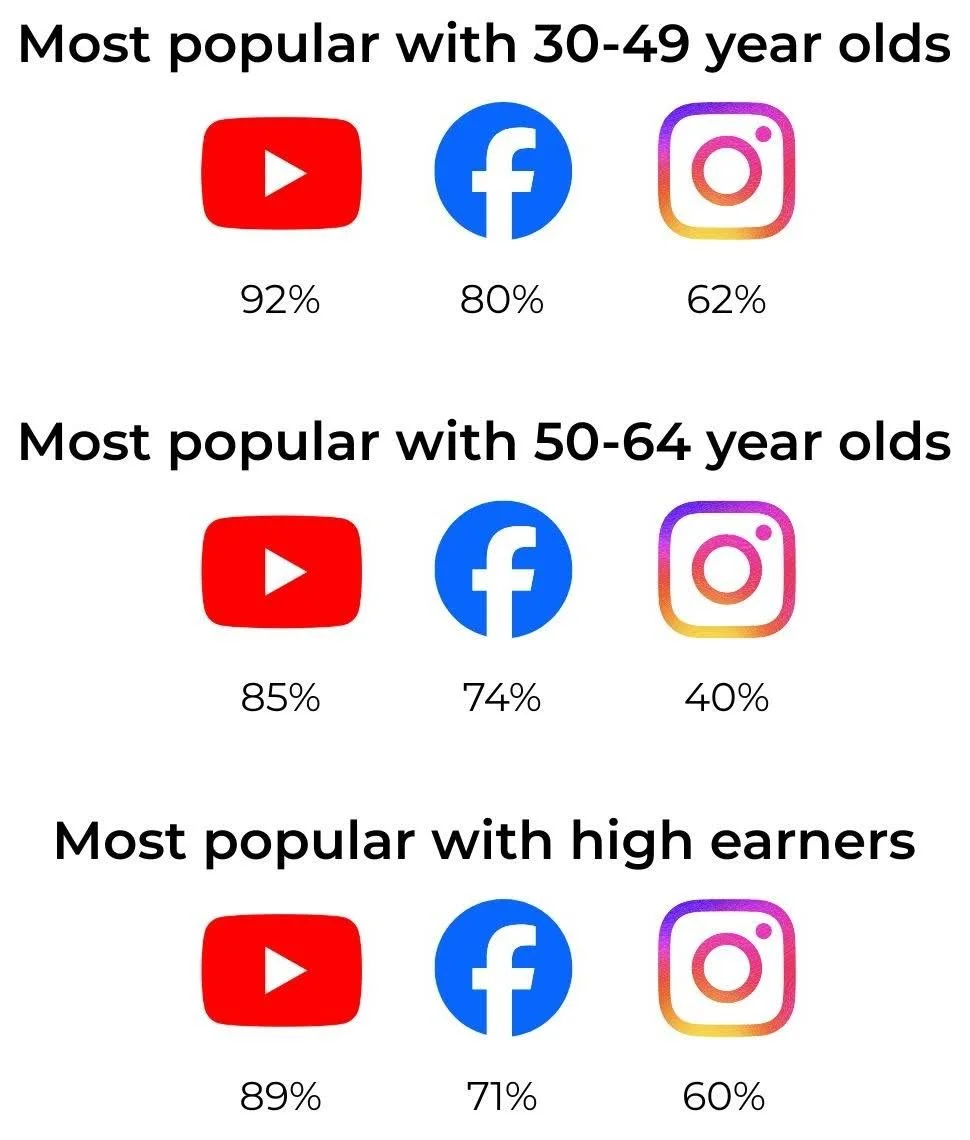
Importantly: This breakdown holds true across age groups and income levels. But there's important nuance when you start digging beyond that, as outlined below:
Women are more likely to use Facebook and Instagram than men. They're also more likely to use TikTok and Snapchat (note: these are all highly visual platforms). Men, on the other hand, are slightly more likely to use YouTube. They're significantly more likely to use Reddit and X, though overall usage of those platforms is lower than the big three.
Additionally, college-educated Americans are slightly more likely to use YouTube than those with some or no college, and significantly more likely to use Instagram and Reddit. They're significantly less likely to use TikTok. (With X, both college graduates and those who report "some college" are more likely users.)
Of course, just because people report using these platforms doesn't mean that they're using them regularly or in a manner that's actually helpful to you. Someone who exclusively watches cat videos on YouTube is unlikely to encounter even the most expertly presented video on Roth conversions unless there's a perfect storm of extenuating factors.
Part IV: How people use social media varies
Recently, a team of researchers asked why we use social media. For marketers, this can be a key, but underrated, factor. Getting in front of people is one thing... but getting in front of people when they're looking for a product or when they're in the headspace to sign up...? That's a different level of engagement.
The research gave four primary reasons people log on to social platforms:
Connection
Attention
Boredom
Fear of missing out
All of these can impact the platforms we use and how we engage. For instance, someone who wants to connect with others is more likely to comment, like, and engage with what other people share. If you have people in your network looking for connection, they can help boost your content in a real way. These are the kind of active users that marketers love.
Folks seeking attention, however, tend to be the opposite—they post a lot but aren't really looking for content from others.
People who sign up or sign in to these platforms due to boredom or a fear of missing out can be a wildcard. They tend to be passive users, scrolling and logging impressions but rarely engaging with what they see.
That doesn't mean that they aren't learning about your brand and taking note about what you're saying... it just means that they're a bit of a black hole when it comes to measurement. They carry a lot of potential, but it's hard to know that until a triggering event motivates them to act.
Want to learn more? Sign up for our newsletter to get insights like this before everyone else.
If you’re a financial advisor, set up a free consultation to see how you can level up your marketing.